Atlanta University Center Historic District
A National Historic District where student activism and academic excellence converged to change history
"Here lies the tragedy of our time: not that people face poverty—for all know struggle; not that people commit wrongs—for who among us is virtuous? Not even that people live in ignorance—for what constitutes truth? Rather, the real tragedy is how little understanding exists between human beings." — W. E. B. DuBois, The Souls of Black Folk
Recognized as a National Historic District, this extensive six-campus academic center encompasses four institutions that played pivotal roles in the struggle for civil rights: Morehouse College (often called "the Black Harvard"), Spelman College, Clark Atlanta University, and West Hunter Street Baptist Church.
Martin Luther King, Jr., earned his degree from Morehouse College, where a generation of activists was nurtured. Morehouse students Lonnie King and Julian Bond orchestrated sit-ins, boycotts, and marches across Atlanta. Spelman student Ruby Doris Smith became a driving force behind freedom rides, sit-ins, jail-ins, and voter registration campaigns. Distinguished civil rights intellectuals W.E.B. Du Bois and Whitney Young, Jr., held teaching positions and department chairs at Atlanta University. Rev. Ralph Abernathy served as pastor of West Hunter while leading the Southern Christian Leadership Conference.
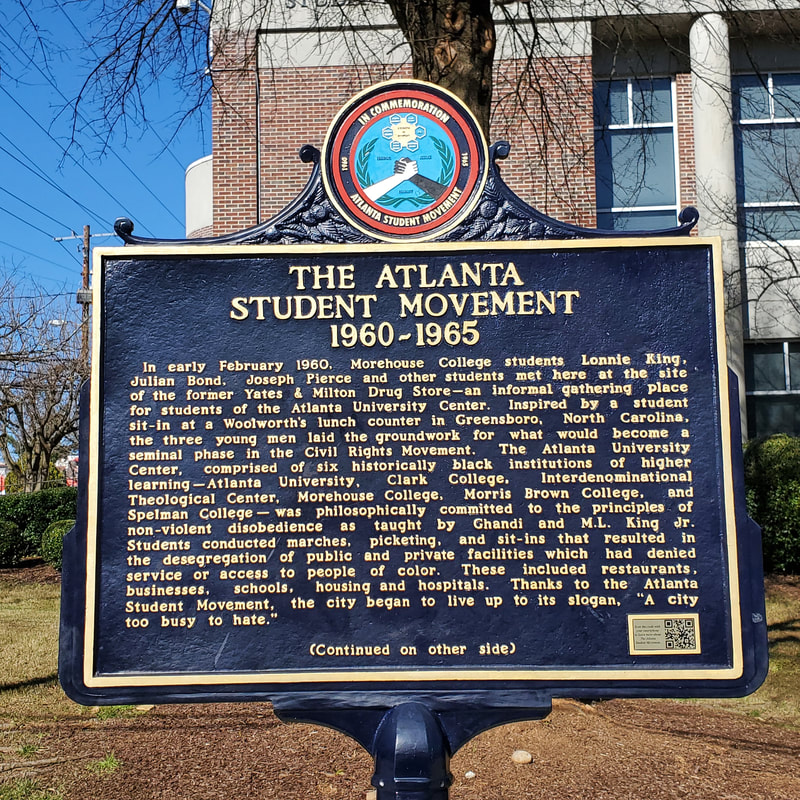
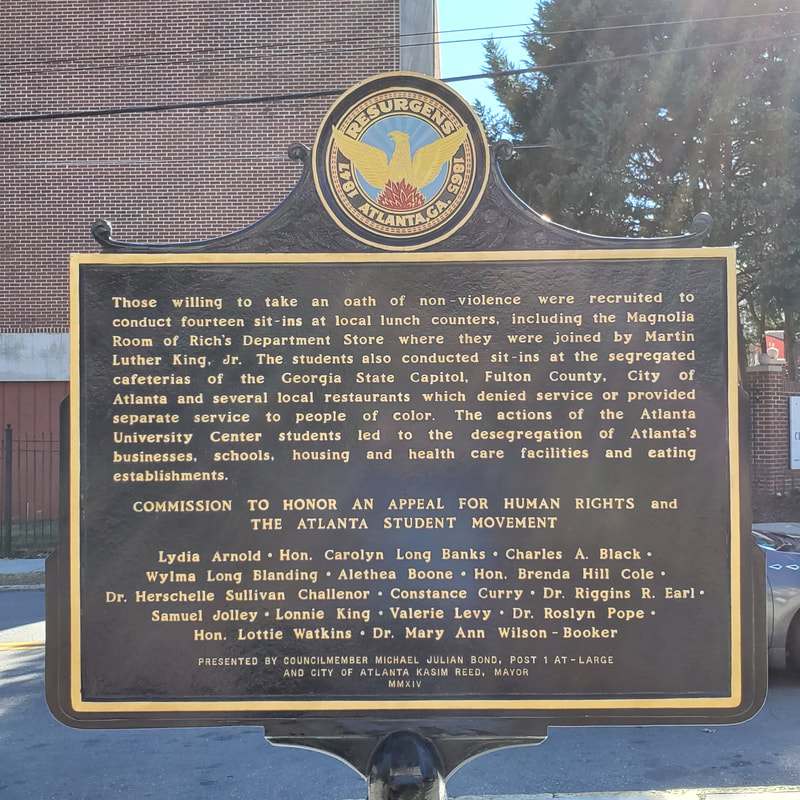
The Student Movement
In November 2010, activists from the Civil Rights era received recognition when Atlanta renamed a portion of Fair Street to Atlanta Student Movement Boulevard in their honor.
Student-led demonstrations in Atlanta launched in March 1960 with 80 impeccably dressed students conducting eight synchronized protests. Julian Bond's contingent staged a sit-in at City Hall's municipal cafeteria, beneath a sign reading "PUBLIC IS WELCOME." Lonnie King led 35 protesters to Rich's Department Store. They were soon joined by Rev. Martin Luther King, Jr., who would spend his first night in an Atlanta jail as a result.
As the Atlanta movement progressed, student activists initiated a publicity campaign to engage black adults on the sidelines—black consumers with purchasing power at Rich's. "Close your account with segregation," the students urged. "Open your account with freedom." Nearly every black adult in Atlanta heeded this call, and Rich's felt the economic impact.
In March 1961, black community leaders negotiated a compromise with city merchants. In exchange for an immediate cessation of protests, store managers agreed to integrate their lunch counters, though implementation was delayed until court-ordered school desegregation took effect in September. Within the Atlanta University Center, Stone Hall (now Fairchild-Stone Hall) served as the hub of university activities and is now designated a National Historic Landmark.
Must-Watch Videos
Charles Black discusses the founding of the Atlanta Student Movement...
Lonnie King remembers the march to the Capitol and the dangers students confronted...
The Honorable Julian Bond reflects on the impact of the Atlanta Student Movement and the renaming of Fair Street to Atlanta Student Movement Boulevard...
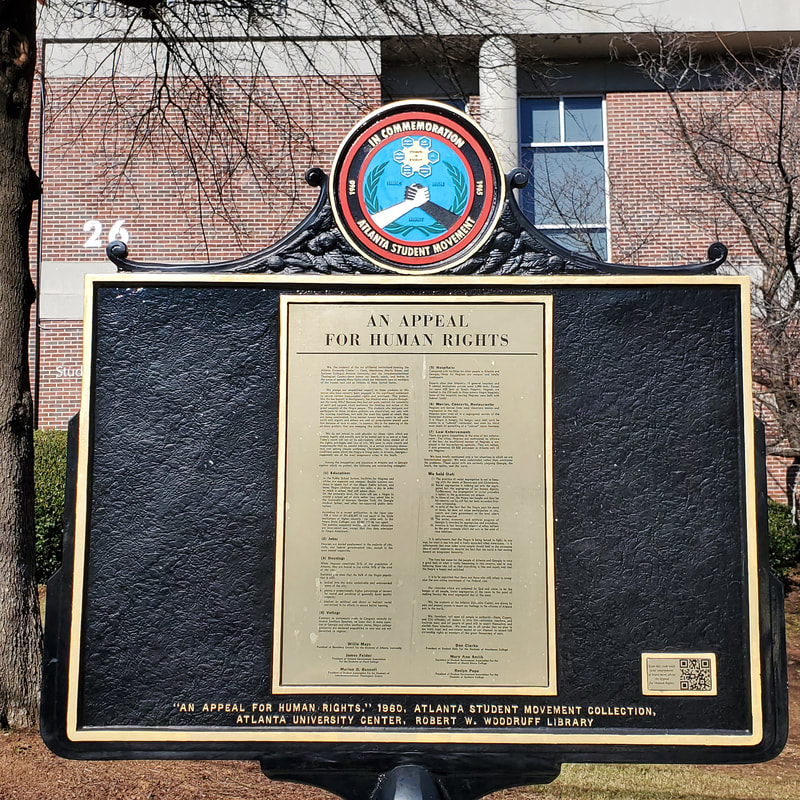
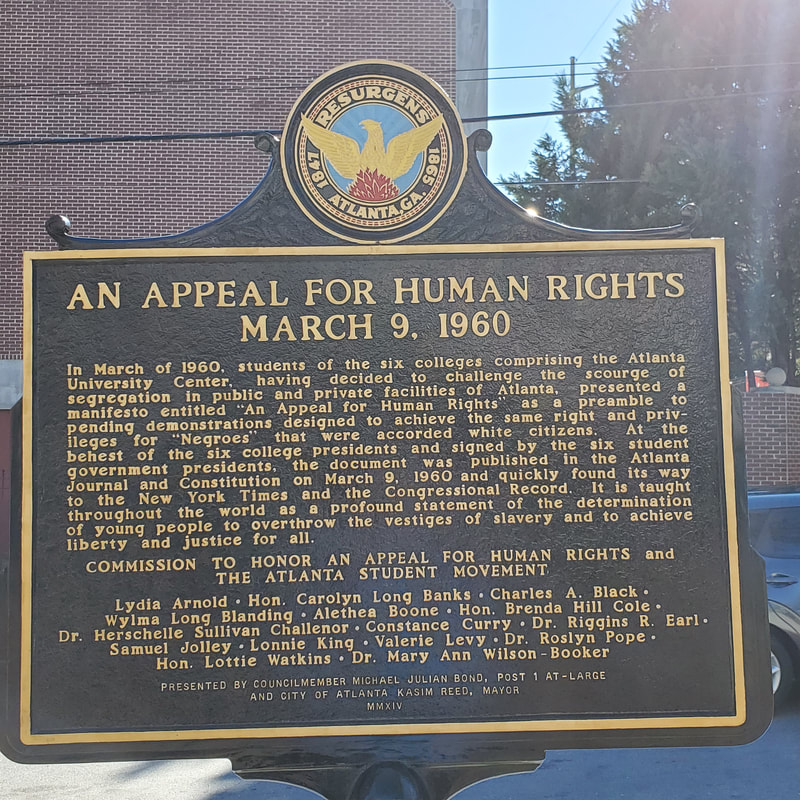
An Appeal for Human Rights
In March 1960, students from the six colleges comprising the Atlanta University Center decided to confront segregation in Atlanta's public and private facilities. They presented a manifesto titled "An Appeal for Human Rights" as a preamble to upcoming demonstrations designed to secure equal rights and privileges for Black citizens. Supported by the six college presidents and signed by the six student government presidents, the document was published in the Atlanta Journal and Constitution on March 9, 1960, and quickly reached the New York Times and the Congressional Record. It is studied worldwide as a powerful statement of young people's determination to dismantle the remnants of slavery and achieve liberty and justice for all.
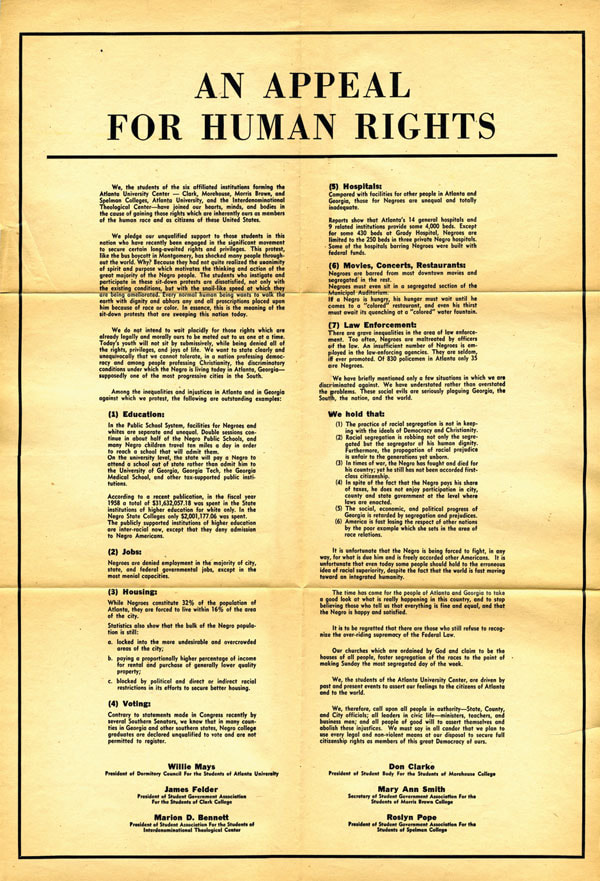
An Appeal for Human Rights was drafted by Roslyn Pope and other students of the Atlanta University Center after the students, led by Lonnie King and Julian Bond, were encouraged by the six presidents to draft a document released on March 15, 1960.
Dr. Roslyn Pope, who authored "An Appeal for Human Rights," shares her story...
Points of Interest
- Atlanta Student Movement Historical Marker
- Chapel Treasures at Morehouse College
- Herndon Home Museum
- West Hunter Street Baptist Church
All of these can be found on the Atlanta Freedom Trail Interactive Map
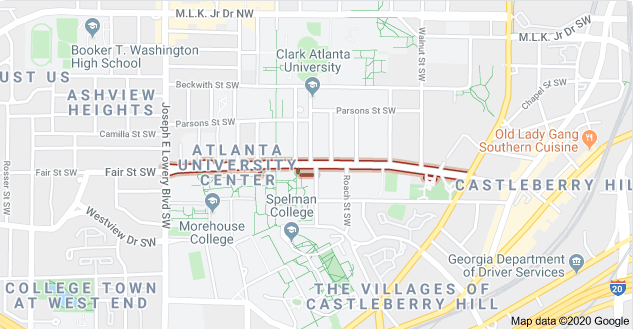
Atlanta Student Movement Boulevard (formerly Chestnut and Fair Streets) runs east and west through the heart of the Atlanta University Center.
Learn More
- Atlanta University Center Consortium
- Atlanta University Center Historic District (US NPS)
- Atlanta Student Movement (City of Atlanta)
- AUC: Atlanta's economic mobility machine (ABC)
- New Atlanta street name honors student movement (AJC)
- Civil Rights Trail (GHS)
- Clark Atlanta University History
- Morehouse College Legacy
- Morehouse School of Medicine
- Spelman College History
- Morris Brown College History
Getting There
- Freedom Trail Interactive Map
- Google Maps
- ASM Historical Marker
- The Atlanta University Center is within walking distance of the Ashby and Vine City MARTA stations
- Limited parking is available at this site
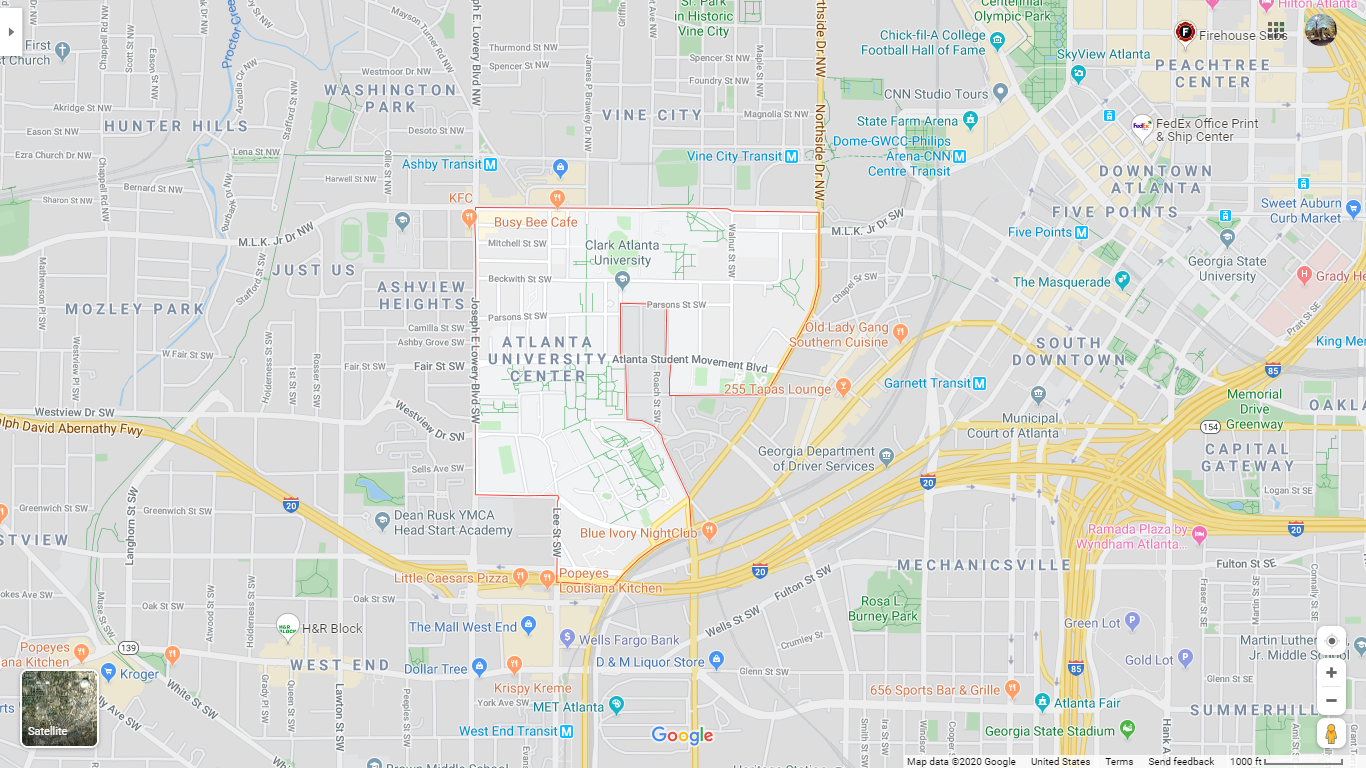
Atlanta University Center is located in SW Atlanta, just west of Northside Drive and just north of I-20.